Sooooo, I came in early today to add another project to my line before school ended.
Nothing special..
Just a simple distortion circuit that I got from google.
I plan to actually go a little farther with it because the rhythm guitarist of my band sure can use one.
For now, it's just on and off, but I plan to add volume controls using a 100k pot and distortion controls using a 1k pot.
Hopefully, for being a simple distortion, it will sounds somewhat decent.
And hey! There's the guts! I just put dat shiit in a plastic temporary housing, but at least it looks better than my talkbox..
Monday, September 16, 2013
Personal Guitar Junk Issues =(
Those of you who didn't know, my car got broken into recently and a bunch of stuff got stolen including my beautiful Ernie Ball Musicman guitar =(
So I went back up to Washington to grab the guitar that me and my construction buddy have been working on for the last year. Unfortunately, he didn't finish it like I had hoped, so I had to do it myself. I had to install the pickups (which really sucks). I also brought down a guitar that I put together when I was a wee lad, but smashed after a show in high school, soooo I got to redo the pickups on that one too, hooorahhhh. But, they're both working, and I have some temp guitars before the insurance (hopefully) covers my loses so I can buy a new guitar.
Ghetto-ass talkbox
Just an update on my talkbox.
Tis all done, it's nothing too crazy, but it was a pain in the butt to put together especially when it came to the housing.
For the housing I just used an electrical box that I picked up at the hardware store.
To connect the rubber tube, I used a copper pipe joint and crazy-glued it onto the box.
From there I glued the speaker to the hole where the copper joint sits.
The circuit I used was a simple mono amp circuit.
Besides from the motorboating when the pot is not either on 1 or 10, it works like a charm.
Woop!
Tis all done, it's nothing too crazy, but it was a pain in the butt to put together especially when it came to the housing.
For the housing I just used an electrical box that I picked up at the hardware store.
To connect the rubber tube, I used a copper pipe joint and crazy-glued it onto the box.
From there I glued the speaker to the hole where the copper joint sits.
The circuit I used was a simple mono amp circuit.
Besides from the motorboating when the pot is not either on 1 or 10, it works like a charm.
Woop!
Sunday, September 15, 2013
How to fix your headphones without buying a new pair.
Hello fellow audio sound makers,
In this post, I shall go over the process of replacing the eighth inch adapter on the headphones. Almost all studio monitoring headphones are connected through three wires, tip, ring, and sleeve; or ground, left, and right. Most headphones that go bad in one ear is caused by wear and tear on the eighth inch jack. All that simply needs to be done is replace the jack with a new one. Here is the process of doing so:
The first step is to break down the rubber or plastic bearing on the outside of the jack, to get to the actual connection of the wires to the jack. Then.....
Snip Snip. Cut that little guy off, exposing the wires.
All headphone wire is wrapped with magnet wire. The magnet wire is wrapped with enamel in the wire. The enamel is not a conductor, therefore it must be separated from the wire to make the wire conduct. The magnet wire is used in headphone cables for the purpose of providing insulation while keeping the diameter of the wire small. Notice Sudhu doing a splendid job of trying to take that enamel off of the wires.
Once the enamel is scrapped off and an electrical signal can be established, a new eighth inch cable can be soldered on.
PNP vs NPN video: Breaks down the transistors in a very simple instructional tutorial
Hey all!
I found this video to be extremely helpful in describing the difference between PNP and NPN transistors.
Takeaway:
NPN uses a positive signal to allow current to flow through the circuit
PNP uses a ground signal to complete the circuit to allow current to flow through the circuit
http://www.youtube.com/watch?v=F-Cv7CMHoGM
I found this video to be extremely helpful in describing the difference between PNP and NPN transistors.
Takeaway:
NPN uses a positive signal to allow current to flow through the circuit
PNP uses a ground signal to complete the circuit to allow current to flow through the circuit
http://www.youtube.com/watch?v=F-Cv7CMHoGM
JFET vs BJT
In a nutshell, JFETs operate off of voltage while BJTs (Bipolar Junction Transistors) operate of off current. The JFET is much more sensitive making it more accurate, however, is also more susceptible to damage from static electricity.
Link here: http://www.electronics-tutorials.ws/transistor/tran_5.html
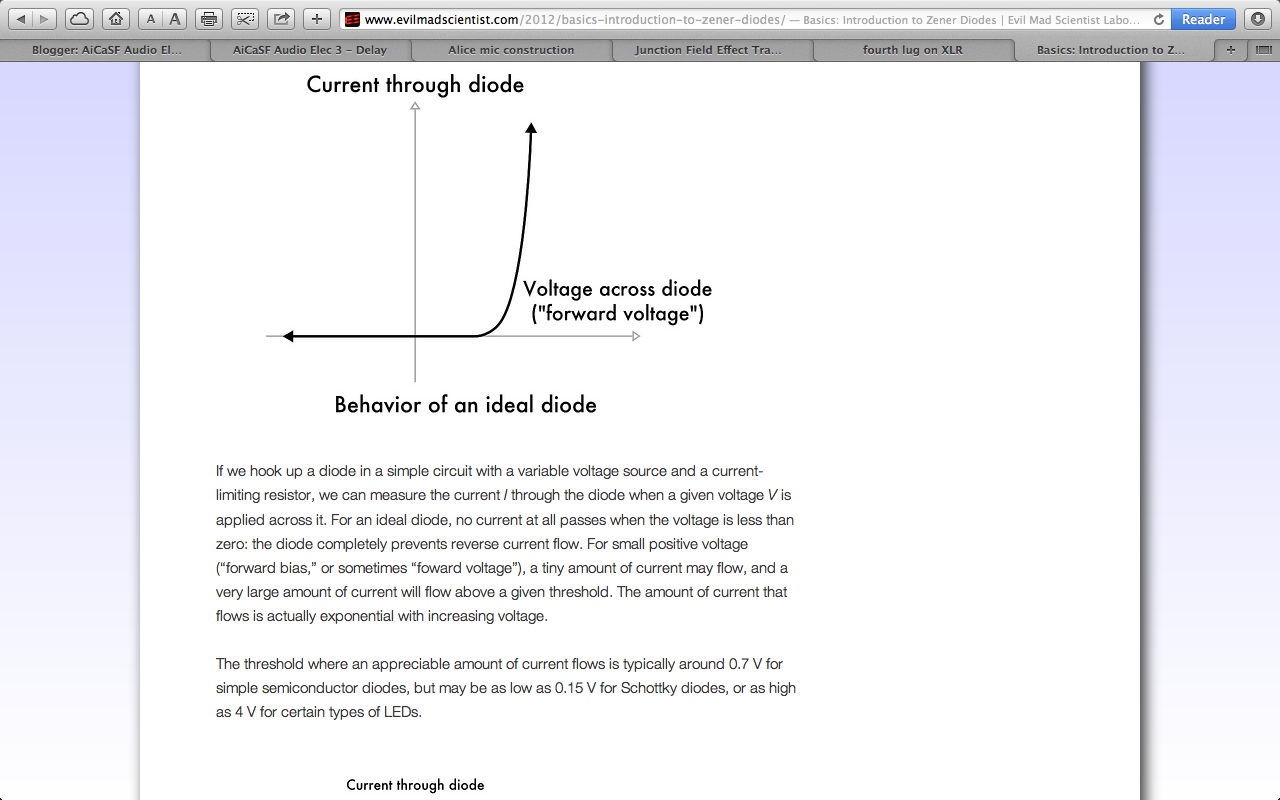
Great info on 12V Zener Diodes
Here's a quick screenshot I thought was very useful...
The full article is here:
http://www.evilmadscientist.com/2012/basics-introduction-to-zener-diodes/
Subscribe to:
Posts (Atom)